iscover “ Concordia Mento ,” a newly recognized chin deformity caused by overfilling. Learn its causes, risks, and safe management strategies for restoring lower-face harmony. contact with us

A Newly Emerging Aesthetic Phenomenon of Chin Overfilling
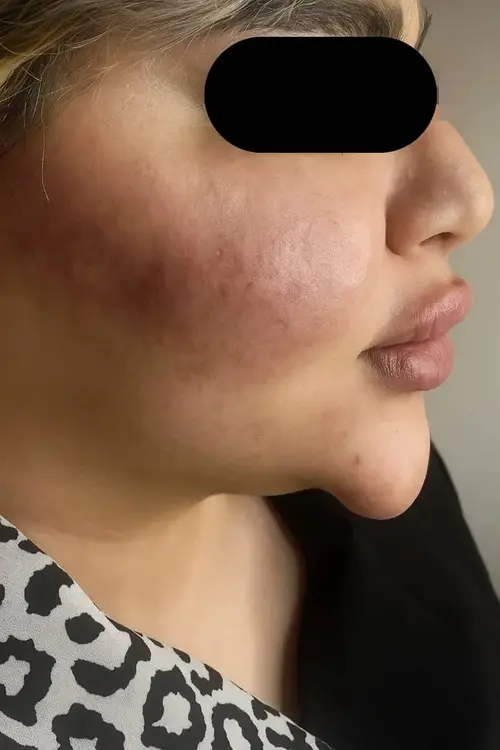
In recent years, aesthetic practitioners have noticed a growing issue: a heavy, drooping chin that separates from the jawline after repeated or excessive filler injections. This deformity, named “Concordia Mento” by Dr. Alireza Fallahi, resembles the downward tip of the Concorde aircraft’s nose — symbolizing imbalance caused by overcorrection.
The phenomenon is particularly observed in the Middle East, where stronger chin projection is culturally favored, and high-volume filler use has become widespread. This article explores its causes, underlying anatomy, and management strategies — offering key lessons to maintain facial harmony.
** more reading : what’s Notalgia Paraesthetica
Understanding the “Concordia Mento”
The defining feature of Concordia Mento is a centrally over-projected chin with downward heaviness, causing a visual break between the chin and the jawline. Patients typically present with:
– A heavy or pendulous chin
– Poor transition between the chin and mandibular border
– Disharmonious lower-face proportions
– Skin laxity or swelling due to repeated filler cycles

Pathophysiology and Mechanisms
Volume Overload and Gravitational Drift
Excessive filler in the midline adds downward weight, exaggerating chin droop and disconnecting the jawline flow.
Lymphatic Stasis and Chronic Edema
Repeated filler injections can impair lymphatic drainage, causing persistent puffiness often mistaken for unresolved filler.
Fibrosis and Filler Encapsulation
Chronic inflammation or microinjections may create fibrotic tissue, reducing elasticity and causing dimpling or surface irregularities.
Microvascular Compression
Too much superficial filler compresses small arterioles from the mental artery, reducing skin perfusion and contributing to laxity.
Imbalance of Soft-Tissue Harmony
Enhancing the chin without lateral support along the jawline disrupts aesthetic balance.
Lymphatic and Vascular Compromise
Chronic chin overfilling disturbs both lymphatic flow and capillary perfusion, leading to persistent swelling and inflammation. Over time, this can cause skin laxity and a “waterlogged” appearance — sometimes mistaken for filler persistence.
Dissolving the Overfilled Chin — Risks and Realities
While hyaluronidase remains the gold standard for reversing filler, rapid or aggressive dissolution can unmask underlying atrophy, fibrosis, or tissue laxity. Common risks include sudden depressions, skin redundancy (“drippy chin”), and need for reconstructive correction.
Management Algorithm
A staged, ultrasound-guided approach is recommended for safety and precision.
Assessment
– Review filler history, type, and total cumulative volume
– Perform dynamic assessment during facial movement
– Use ultrasound to detect filler depth and fibrosis

Stepwise Correction
– Gradual hyaluronidase injection
– Lymphatic massage between sessions
– 2–3 week intervals between dissolutions
Reconstructive Phase
– Microfat/nanofat grafting
– Energy-based tightening
– Mini-genioplasty or implant for severe cases
Prevention
– Balance central projection with lateral jawline support
– Use minimal deep supraperiosteal boluses
– Avoid reinjection before full integration
– Monitor annually with ultrasound
Regional Trend — The Middle Eastern Aesthetic Preference
In Middle Eastern cosmetic practice, a pronounced chin is often a sign of strength and beauty. This cultural preference has led to high rates of chin filler overuse and the rise of Concordia Mento. The lesson: even desirable features can become deformities when anatomical harmony is ignored.
Why “Concordia Mento”?
Inspired by the Concorde aircraft’s drooping nose, this term reflects how a once-sleek chin begins to slope downward from mechanical overload and tissue fatigue — a metaphor for aesthetic imbalance caused by excess.
Key Takeaways
– Overfilling the chin leads to Concordia Mento — a drooping, heavy lower face.
– Pathogenesis involves mechanical, lymphatic, and vascular mechanisms.
– Gradual correction with hyaluronidase is safest.
– Prevention relies on balanced filler design and volume control.
– Early recognition prevents irreversible contour changes.
FAQs
What causes Concordia Mento?
Excessive or repeated chin filler injections that overload tissues and disrupt lymphatic flow.
Can it be reversed completely?
Most cases improve significantly with staged hyaluronidase treatment, though chronic fibrosis may need surgical correction.
How can it be prevented?
By maintaining proportion between the chin and jawline, using minimal filler, and allowing time for tissue integration.
Declaration of Interest
The author declares no conflicts of interest. The term “Concordia Mento” was first introduced by Dr. Alireza Fallahi (Dr Fall Clinic).
References
- Hong GW, et al. Adverse Effects Associated with Dermal Filler Treatments. Clin Plast Surg. 2024.
- Haneke E. Managing Complications of Fillers: Rare and Not-So-Rare. Dermatol Surg. 2015.
- Cotofana S, et al. The functional anatomy of the mental region for injectable treatments. Aesthetic Surgery Journal. 2018.
- Fallahi A. Concordia Mento: Overfilling the Chin and Aesthetic Disharmony. Dr Fall Clinic Clinical Communication. 2025.
- Hong GW, et al. Adverse Effects Associated with Dermal Filler Treatments. Clin Plast Surg. 2024.
- Haneke E. Managing Complications of Fillers: Rare and Not-So-Rare. Dermatol Surg. 2015.
- Cotofana S, et al. The functional anatomy of the mental region for injectable treatments. Aesthetic Surg J. 2018.
- Sundaram H, et al. Long-term effects of repetitive filler injection: implications for facial biomechanics. Dermatol Surg. 2020.
- Rauso R, et al. Lymphatic stasis following hyaluronic acid filler injection: clinical and ultrasonographic findings. J Cosmet Dermatol. 2023.
- Cotofana S, et al. Vascular anatomy of the perioral region and its implications for injectable treatments. Plast Reconstr Surg. 2021.
- Heydenrych I, et al. Delayed adverse events with hyaluronic acid fillers: prevention and management. Clin Cosmet Investig Dermatol. 2018.
- Fallahi A. Concordia mento: Overfilling the chin and aesthetic disharmony. Clinical Communication, Dr. Fall Clinic; 2025.
Book a Consultation
It’s easy and free!